PM Surya Ghar Muft Bijli Yojana 2026: The Complete Residential Solar Subsidy Guide
India is undergoing a massive transformation in residential clean energy, driven by the Central Government’s flagship initiative: the PM Surya Ghar: Muft Bijli Yojana. If you are a homeowner looking to cut your electricity bills to near zero, 2026 is the prime time to transition to rooftop solar. Here is a comprehensive breakdown of the […]
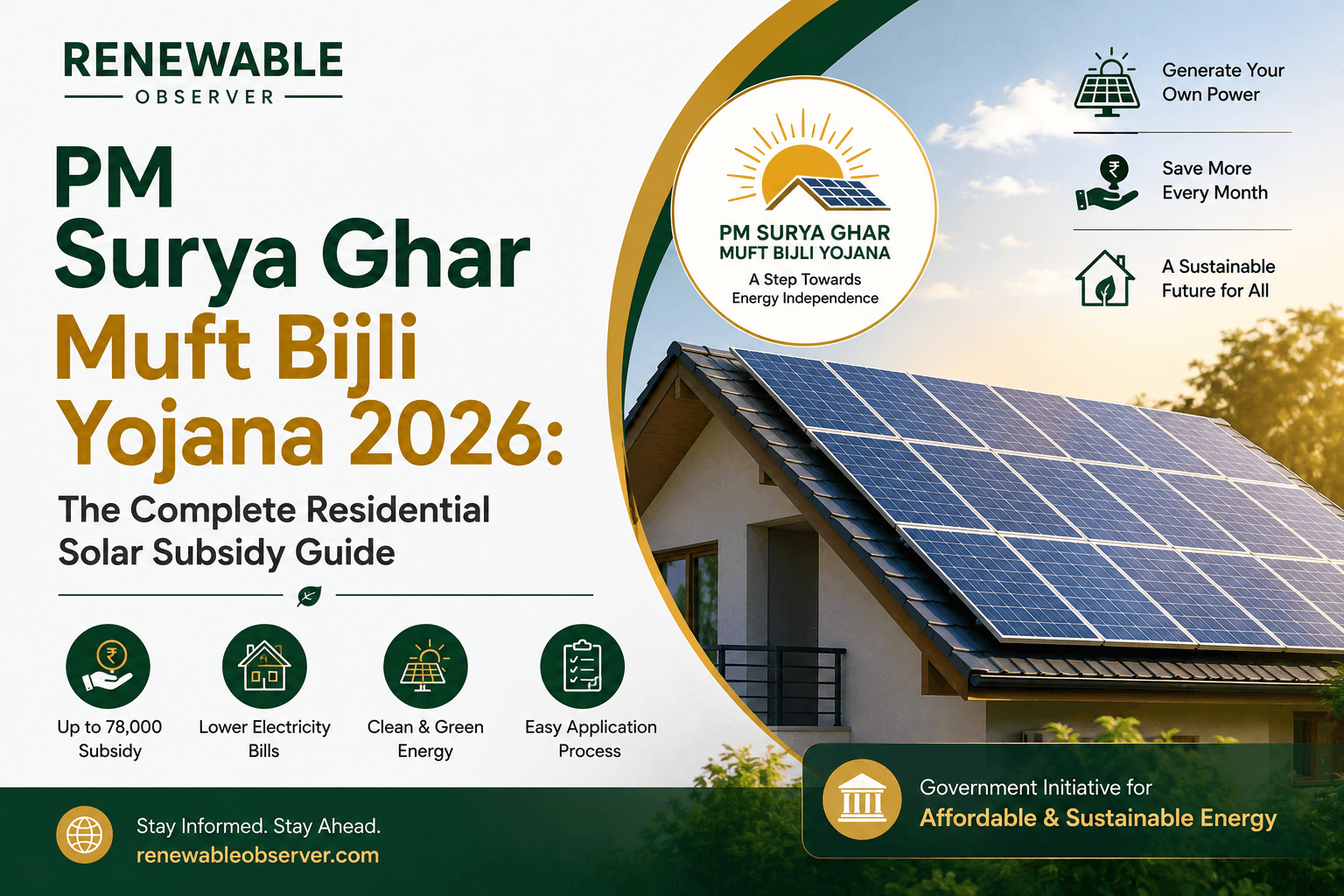
India is undergoing a massive transformation in residential clean energy, driven by the Central Government’s flagship initiative: the PM Surya Ghar: Muft Bijli Yojana. If you are a homeowner looking to cut your electricity bills to near zero, 2026 is the prime time to transition to rooftop solar.
Here is a comprehensive breakdown of the scheme’s current status, exactly how much money you can save, and the critical rules you must follow to secure your subsidy in 2026.
1. What is the PM Surya Ghar Yojana?
Launched to empower residential households to generate their own electricity, the PM Surya Ghar Muft Bijli Yojana is India’s largest residential solar scheme.
- The Goal: The scheme targets the solarisation of one crore households (10 million homes) by the financial year 2026-27.
- The Budget: It is backed by a massive ₹75,021 crore central allocation.
- The Progress (2026 Update): The scheme is moving at an unprecedented pace. As of mid-July 2026, the scheme has benefited 4.65 million households across the country, with roughly 100,000 households installing systems every week.
The core benefit of the scheme is providing up to 300 units of free electricity monthly through a combination of upfront rooftop solar subsidies and standard net metering. This initiative is a vital component of India’s broader renewable energy policy targets.
2. The 2026 Subsidy Breakdown
The Ministry of New and Renewable Energy (MNRE) has simplified the subsidy structure. The Central Financial Assistance (CFA) is fixed based on the capacity of the system you install, capped at a maximum of 3 kW.
The central subsidy is transferred directly to the customer’s bank account via Direct Benefit Transfer (DBT) after the local DISCOM commissions the system.
- 1 kW System: ₹30,000.
- 2 kW System: ₹60,000.
- 3 kW System (and above): ₹78,000 (Maximum Cap).
Note on Larger Systems: If you install a 5 kW or 10 kW system, your central subsidy remains capped at exactly ₹78,000. The system capacity you apply for also cannot exceed your home’s officially sanctioned electrical load, which typically must be 10 kW or below for residential connections under this scheme.
For Housing Societies: Group Housing Societies and RWAs can also benefit, with subsidies of ₹18,000 per kW for common facilities (like lifts and corridor lighting), up to 500 kW overall.
3. State-Level “Top-Up” Subsidies
While the Central Government provides the ₹78,000 base, several state governments offer lucrative “top-up” subsidies to accelerate adoption in local solar energy markets.
- Gujarat: Gujarat remains the national leader in the scheme, currently ranking first with over 1.06 million households covered. The state provides an additional ₹10,000–₹20,000 state subsidy for residential rooftop solar.
- Maharashtra & Uttar Pradesh: Following closely behind Gujarat are Maharashtra with 1.04 million households and Uttar Pradesh with 676,000 installations. UP offers a flat state subsidy of ₹30,000 for systems of 3 kW or more, bringing the total potential subsidy to ₹1.08 lakh.
- Delhi: Similar to UP, the Delhi government offers a state subsidy capped at Rs. 30,000 for systems of 3 kWp or more, allowing residents to claim a cumulative subsidy of up to Rs. 1.08 lakh.
- Rajasthan: Residents in Rajasthan can receive an additional ₹17,000 state top-up via RREC.
4. Critical 2026 Rules: The ALMM Mandate
The most important rule to be aware of in 2026 is the strict enforcement of the Approved List of Models and Manufacturers (ALMM).
- The Requirement: To qualify for the subsidy, you must use panels that are manufactured in India and listed on the ALMM.
- The June 1, 2026 Update: The rules have become stricter. As of June 1, 2026, compliance extends to ALMM List II for cells. This means the solar modules must not only be made in India, but they must also be manufactured using domestically certified Indian cells.
- The Risk: Using non-ALMM equipment to save on upfront costs is the most expensive mistake in residential solar in 2026. If your panels are not on the current ALMM List at the time of installation, your entire subsidy claim will fail.
5. How to Apply
The entire application process has been digitized through a national portal.
- Register Online: Visit the official PM Surya Ghar National Portal and register using your mobile number and Electricity Consumer Number.
- Feasibility Approval: Your local DISCOM will review your application and grant technical feasibility, usually within 7 to 21 days depending on feeder loading.
- Choose a Vendor: You must select a registered, DISCOM-empanelled vendor from the portal to install your system.
- Net Metering & Commissioning: Once installed, you submit a completion report, and the DISCOM will inspect the system, fit a Net Meter, and generate a commissioning certificate.
- Receive Funds: After submitting your bank details, the central subsidy is typically credited to your account via DBT within 30 to 45 days of commissioning.
Read Next
Daily Updates
Maharashtra Invites PPP Bids for 200 MW Floating Solar Project with BESS and 22.5 MW Yeldari Hydroelectric Plant Modernisation
Daily Updates
Inox Wind Secures INR 1,600 Crore, 200 MW Repeat Turnkey Wind Order from NLC India
Daily Updates
DCM Shriram Reports 9% Revenue Growth and 12% Increase in PBDIT in Q1 FY27 on Consolidated Basis
Daily Updates